
Caught on Trains
A film set in 1980 brings ten reasons to be cheerful. Plus this week's Sunday roundup

Are things really, honestly worse than they have ever been? The dismal sight of this week’s local election results could easily give us that impression. (So could the quantity of delays and cancellations on GWR the other day when I was en route to the Chipping Campden Literary Festival – but I was one of the lucky ones with a train that existed and a reserved seat on it).
Revisiting other times, though, suggests that maybe we have short memories and should count our blessings occasionally.
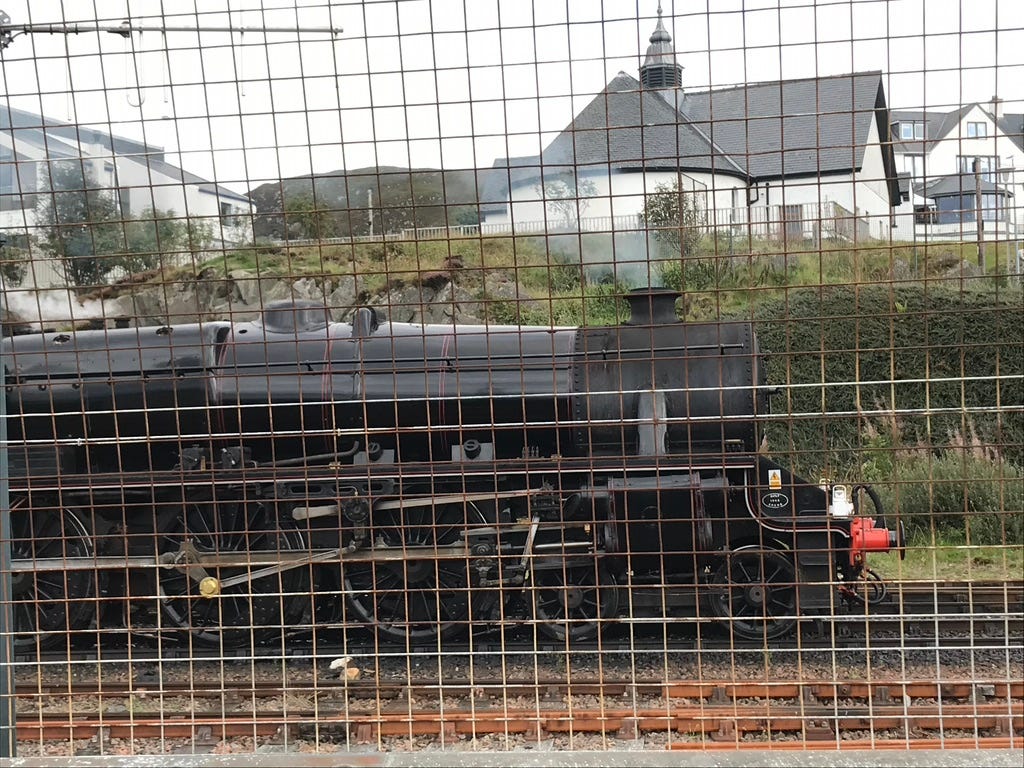
The BBC occasionally dips into its back catalogue and pops pure gold onto the iPlayer. The latest film I’ve stumbled across is Stephen Poliakoff’s Caught on a Train, from 1980. It stars a young Michael Kitchen as Peter, a publishing PR on his way to a book fair in Linz, and the magnificent Peggy Ashcroft as the grand, fur-wearing, implicitly ex-Nazi Frau Messner from Vienna, thrown together as they travel from Ostend to Austria on the rails and sometimes off them. It resembles one of those nightmares in which you are trapped from all sides - hooligans targeting you, drugged up and bleeding, a love interest that shafts you, getting off a train and missing it as it leaves…
Frau Messner’s continual demands that other people do her bidding, and her refusal to wait her turn obediently, press all the wrong buttons for Peter, who instantly loathes her. After he agrees to unscrew a blue lightbulb to help her sleep and is promptly arrested at the border for tampering with train property, her refusal to take no for an answer saves his bacon. He doesn’t even say thank you.
By the end they have developed an unspoken co-dependence, but Frau Messner proves the more perceptive. Your problem, she tells him, is that you’re only interested in your career; you don’t really care about anything. Her words quietly hit home. Peter departs as an older and perhaps slightly wiser man.
I was 14 in 1980 and the unsettling ambience and grey, miserable setting of this film feels…familiar. Let’s not forget how grim those times were.
Thatcher had recently been elected and was busy dismantling the few elements that made life better for people, notably jobs, social housing, functioning health care and a well-funded arts scene. The miners’ strikes were round the corner. Public transport was creaking; airports were maybe less stressful than they are today, but there were fewer options to travel. Terror threats abounded: the IRA here, the Bader-Meinhof Gang in Europe, among other issues. The far side of the Iron Curtain was another world.
Society was polarised, often to a pugnacious degree. Several years later, caught at university between ‘gown’ rugger-buggers and Hooray Henrys in stripy shirts vomiting outside the college bar and ‘town’ hoodlums who would harass any student they could lay mitts on, the safest place was…a practice room. If you could find one.
What’s better now? Here are ten reasons to be cheerful.
• To me, it is a small but crucial improvement that you can walk all the way through a train without impediment. The other week a weirdo on the tube started trying to take photos of me. I don’t like the things people can do with photos now, such as AI stripping or faked facial recognition. At least I could simply get up and walk away.
• Today most parents don’t let their kids travel long distances on their own aged 11; and they teach them how to ride bikes. This is responsible.
• In the 1980s, going jogging was sometimes thought weird. Now fitness and health are taken much more seriously. Exercising is A Very Good Thing and a great many more people do it. Hooray for the gym. And the reduction of smoking is a humungous improvement too.
• Today when sexual abuse is called out, sometimes it is taken seriously. In the early to mid 1980s, you could not do anything about it.
• You have a better chance today of surviving some types of cancer (not all, alas - and much faster diagnosis and treatment would help) and of living longer and better if suffering debilitating illnesses that formerly might have killed you faster.
• Electric cars aren’t as plentiful as they should have been by now, but they do exist.
• Women’s increased empowerment is making a difference in all manner of ways, and not only among conductors, composers and directors. It’s not easy and it has not progressed far enough, but it really has progressed.
• The food is better. Much better. All I remember from Britain in the 1980s is soggy deep-pan pizza, greasy kebabs, Chinese dishes full of MSG, and some admittedly excellent curries. Today, within a five-minute radius of my home, there are several good Italian places, Lebanese, Persian, Korean, sushi, Argentinian, Nepalese, GF galettes, a gastropub, a too-fabulous Gelateria, and a seemingly infinite number of cafes offering as many permutations of coffee as you care to dream up.
• We can, at the touch of a button, see film of Myra Hess, Vladimir Horowitz, Jascha Heifetz and the rest of them. The impact of the Golden Age megastars on young musicians today is extremely valuable.
• If I think of the number of days - weeks, months, years - I used to spend transcribing audio interviews, I could howl. Now, however, when you record an interview it can be transcribed automatically by software that may still spell Chopin as Shopping, but is improving all the time. I’ve got half my life back.
This could continue, but the general point is that things might feel awful in many and frightening ways, but they always did. Thank you, Stephen Poliakoff.
What I’ve been hearing
No concerts this week, as I’ve been on the road and rails. I have, however, been listening to certain things in my study, notably an old (?) recording of Verdi’s Un ballo in maschera from 1985, conducted by Georg Solti and starring Luciano Pavarotti in his prime.
My God, what a voice. The focus, the strength, the wealth of character in that sound! They don’t make ‘em like that any more… yet did they ever? Pavarotti was a one-off. Sometimes we’ve heard of singers who were encouraged by him, or were considered his potential successors; none of them, though, have ever quite filled his substantial shoes. None can.
I have an inbuilt resistance to a certain type of Italian opera that involves high-spirited rhythms and jolly tunes while all hell is supposedly breaking loose in the drama, and this piece is usually no exception (the nadir remains Il trovatore). But with Solti’s volcanic energy and the grab-em-by-the-throat charisma of Pavarotti’s voice, Verdi’s tale of doomed love and murder becomes startlingly irresistible.
Hearing the first entry of Riccardo/Gustavo, my cat (whom I’d thought hard of hearing, given the magnitude of her meow) galloped in, apparently thinking she was being summoned in purrson by the greatest tenor of his day.
Decades ago, working at Rhinegold Towers, I used to sit opposite the deputy editor of Opera Now, an Amazonic young woman who had joined the company after a spell as press officer at the Royal Opera. Her backstage stories could fill a volume or several. Once she had spotted someone carrying a tray piled high with a veritable tower of bacon sandwiches and one cup of coffee. She thought it was for the stagehands, but it was, she said, Pavarotti’s lunch.
What I’ve been writing
It’s been a long-range writing week. I’ve drafted some programme notes, plus a lengthy piece for here that I may put out soonish. Also, I’ve been working on a book proposal. Must be mad, I know, but I still have a Things to Write wish list as long as both arms. Convincing proposals are even harder to fashion than the actual books, however, so it takes time.
What I’ve been reading
Far too much in the papers about the local elections, so I’m only halfway through the book I’d hoped to mention today. Here on Substack, however, I’ve been reading the excellent Leah Broad’s Songs of Sunrise, in particular this piece in which she responds to the Michael Jackson biopic, then analyses and articulates our motivations for preserving what one could call Great Man syndrome even when it means defending the supposedly indefensible. We need a more nuanced way to consider artists’ lives, she suggests. As it happens, this makes a fascinating juxtaposition for the volume above. More anon.
Three of the best for this week
Annoyingly, two of these are on the same night, Tuesday 12 May.
Middle Temple Hall is Where Great Mezzos Meet: Sarah Connolly and Beth Taylor are giving a joint recital, with Julius Drake at the piano. The programme includes solos and duets and we’re promised music by Schumann, Britten, Fauré, Holmès, Tailleferre and more. This doesn’t happen every day and I’ve signed up to go hear. Tickets here.
Regrettably, it clashes with the Royal Philharmonic Orchestra under Vasily Petrenko at the Royal Albert Hall, a concert pairing the Korngold Violin Concerto, with excellent soloist Ray Chen, with Mahler’s Symphony No. 5. Finding good Mahler 5s can involve much scrabbling through haystacks. Petrenko, however, conducted such a magnificent Mahler 8 a few years ago, so full of flair, detail, narrative drive and real understanding, even in such a totally bonkers piece, that I’d place a bet on him being the person for the job. Tickets here.
Over at Wigmore Hall it was not easy to select just one of this week’s crop of glories. But finally: the Ebène Quartet continues its series of the complete Beethoven String Quartets with concerts on Thursday 14 (Op. 18 Nos. 4 & 5, and Op. 127) and Saturday 16 May (Op. 18 No. 2, Op. 135 and Op. 131). The Ebène’s joie de vivre and gratifyingly tight-knit ensemble combine into a sort of HD-concept of quartet playing; their Beethoven series, ahead of next year’s big anniversary, should vault satisfyingly off the page. Tickets here.
It was surprising to learn, while researching Myra Hess and the National Gallery, that the most popular concerts in that celebrated wartime series were string quartets. The Griller Quartet, her protégés, were especially loved and performed there 60 times - inspiring a teenage Viennese Jewish violinist, whom Myra had helped to extract from internment in the Isle of Man, to aim to devote his life to string quartets. His name was Norbert Brainin. (Speaking of Wigmore, here’s the link again for my event there with Nigel Hess on 23 May, 1pm…)
We both remembered Caught on a Train from its original broadcast, or another repeat years ago, but we watched it again last night. it is so brilliant! I couldnt remember seeing it in colour, and certainly when I moved in with David in 1982 he only had a little square black and white TV, so it's quite possible if it was that long ago that I never did until now. A lot of things have indeed improved, not least the advent of mobile phones, so that if everything is going tits up on a journey you can usually alert whoever you are planning to meet. Unless you have no signal, the train is failing to charge your phone battery, or the other person's phone is switched off, of course.