
Talking about ANGEL'S BONE
ENO's controversial new production of the opera by Du Yun and Royce Vavrek opened last week in Manchester and comes to the London Coliseum in the autumn. I talked to the director, Kip Williams

Before Angel’s Bone hit the stage, ENO commissioned me to write an article to syndicate around Manchester. It rather got swamped by all the national coverage, however, so it didn’t come out ahead of the show. The production has since received high acclaim and much respect - if not exactly love, given the topic, which is human trafficking.
It’s not easy. It’s not meant to be.
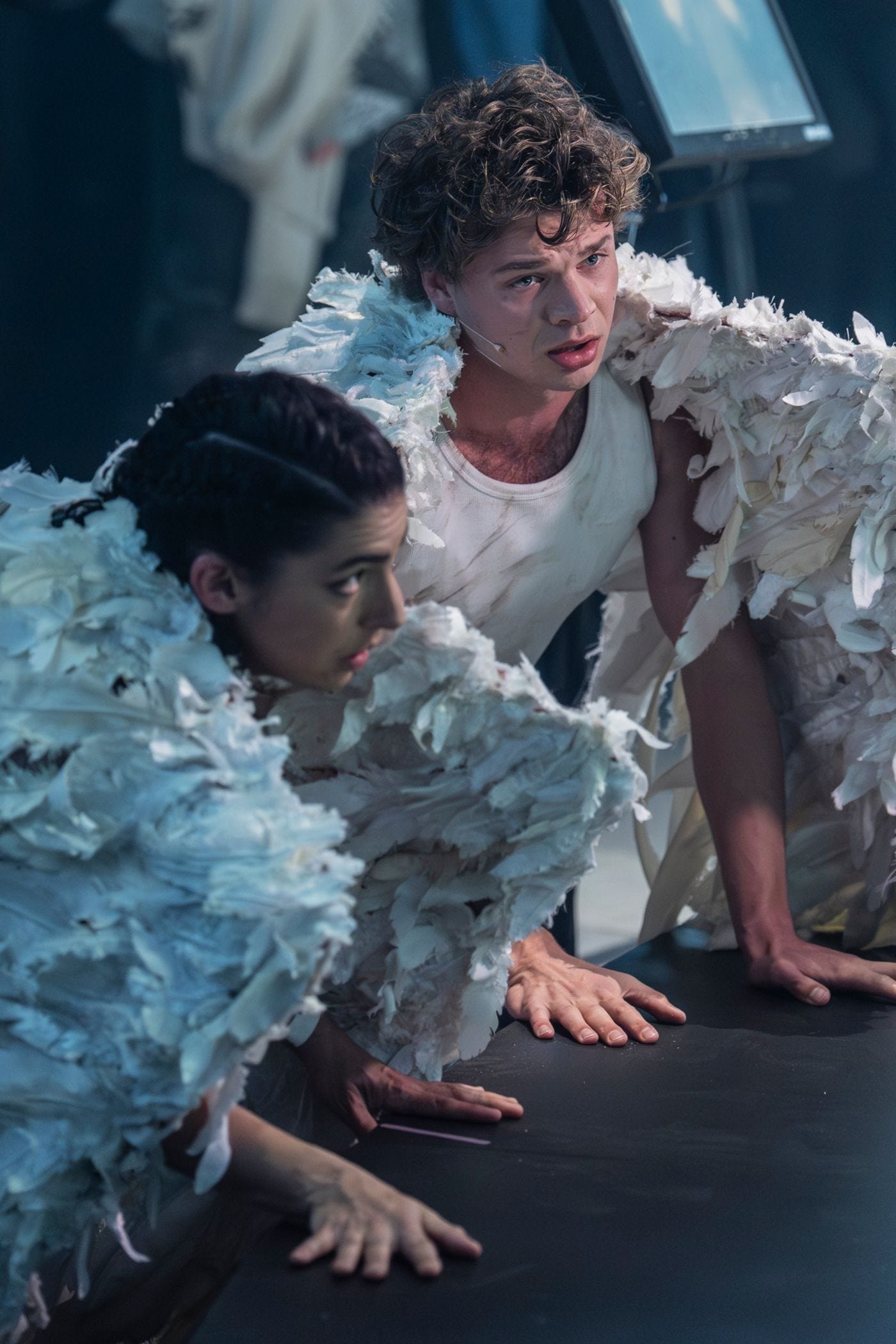
Opera is a magical world in which music, visual arts, drama and legend meet and blend as nowhere else. English National Opera’s (ENO) first production created especially for its new second home, Manchester, is no exception.
Angel’s Bone, with music by the Chinese American composer Du Yun and a libretto by the playwright and filmmaker Royce Vavrek, brings to life a tale of two angels who long for the pleasures of Earth and land in a suburban garden – only to face a nightmarish fate.
In charge of the production is the multiple-award-winning Australian director Kip Williams, who was artistic director of Sydney Theatre Company from 2016 to 2024 and on these shores is celebrated for his Gothic trilogy of The Picture of Dorian Gray, The Strange Case of Dr Jekyll and Mr Hyde and Dracula.
Speaking to me in a lunchbreak during rehearsals, Williams is battling jet-lag, yet he is more than excited about progress. He had jumped at the project: ‘I’ve never really encountered a piece like it and felt very lucky that I was being asked to consider directing it,’ he says.
Bold, creatively risky and meaty in subject matter
He is also thrilled to be in Manchester: ‘I couldn’t be more honoured to be doing ENO’s first new production in Manchester, and it’s going to be my first work there too,’ he says. ‘I’ve visited a couple of times, and it just feels cool! There’s a great music scene, and it feels very culturally engaged.
‘Manchester audiences are incredibly adventurous. They like artistic works that are bold, creatively risky and meaty in terms of subject matter. And the triumphant success of Factory International and the creation of a space like Aviva Studios is testament to that. When you’re staging an opera that is not only so formally radical, but also so overtly political, it feels like an amazing audience to connect with.’
The supernatural narrative is a filter for the all too current theme of human trafficking. The angels are captured by the owners of the house, known only as Mr and Mrs Xe, who cut off their wings, imprison them and prostitute them to amass wealth for themselves. Williams says that the fantastical element of the story can help us cope with a drama in which the levels of violence risk being overwhelming.
‘One aspect of genius that Du Yun and Royce Vavrek bring to the work is the allegorical context,’ he says. ‘It gives the audience imaginative permission to enter into this dark world, by creating a fictional distance between the audience and the drama by telling a story in which angels exist.’
A devastating allegory…
At a time when the Epstein Files are causing an ongoing international outcry, Williams says that the subject could scarcely be more relevant. ‘I’ve been devastated, shocked and appalled by the revelations as they’ve continued to come out. It’s been gobsmacking to see this opera – which was written nearly a decade ago – become increasingly a work that speaks to the very centre of this rupture in the social fabric that we’re living through.
‘It is Du Yun and Royce Vavrek’s deliberate decision to approach this topic with searing honesty, via an allegory that permits an audience to travel right to the centre of this action that feels so devastating and real. It forces an audience to acknowledge their own complicity within it.’
ENO, which performs international works in the English language, has in recent years built a remarkable reputation for contemporary operas on challenging topics. Following a powerful staging in 2022 of Poul Ruders’ The Handmaid’s Tale, its production of Jake Heggie’s Dead Man Walking has just won an Olivier Award. Angel’s Bone seems an ideal match for its skills: the opera won a Pulitzer Prize in 2017, but has not previously been fully staged in the UK.
Its music is eclectic: Du Yun draws on everything from cutting-edge electronics to Gregorian chant, and from cabaret to punk rock. ‘I’m fascinated with mashing up genres,’ Williams says. ‘That’s something that I was drawn to when I first listened to the work. You can play with the moments where it feels entirely acoustic and of the body, and then with these moments when the body is augmented and distorted.
‘You can surround the audience with the sound, and it can be utterly overwhelming and immersive. The kaleidoscopic quality is extraordinary. It speaks to the piece’s tensions between purity and defilement and between the organic and the dehumanised, evoking the opera’s complex emotional landscape.’
A tale of two stages
His reference to ‘immersive’ is symptomatic. For Manchester he is creating an in-the-round staging in which the audience stands and is surrounded by live-filmed projections. For its transfer in the autumn to the London Coliseum, he is reimagining it for a seated audience in a traditional proscenium-arched theatre.
‘It’s one of the biggest challenges I’ve encountered as a director: conceiving a work for two almost diametrically opposed theatrical spaces,’ he acknowledges, ‘but it’s also been a thrilling part of the process.’ I’ve caught him at an exciting moment of the rehearsals: ‘In the rehearsal room we have a full 13-metre revolve [in the stage], all the elements of the set and three roving cameras with their operators, building the cinematography. It’s really amazing and very playful.’
Williams is working closely with a striking team of collaborators. The designer is the Tony and Olivier Award-winning Marg Horwell, a longstanding colleague with whom Williams has enjoyed recent West End and Broadway hits including Dracula, starring Cynthia Erivo, at the Noel Coward Theatre, as well as The Maids at Donmar Warehouse (which is transferring to off-Broadway) and The Picture of Dorian Gray in both London and New York.
As for the performers, these include the contemporary music experts Allison Cook as Mrs Xe, Rodney Earl Clarke as Mr Xe, Matthew McKinney as Boy Angel, and the male soprano Keith Pun, with the role of Girl Angel taken by the Swedish cross-genre musician and voice actress Mariam Wallentin. The UK premiere in Manchester is presented in collaboration with Factory International and the BBC Philharmonic Orchestra; Manchester-based vocal ensemble Kantos Chamber Choir plays a crucial role and will also be in the London performances, where the Orchestra of English National Opera performs. Baldur Brönnimann is the conductor.
Opera as activism
Du Yun herself is a ‘composer, performance artist and activist’, so perhaps it is no surprise if this opera is more than an opera. It can raise awareness of its devastating subject and perhaps encourage its audience into activism against this in real life. Yet it also does something for which opera is perfectly suited: catching emotions so intense that they go beyond verbal expression.
‘In the past five to ten years, many young opera composers have been putting challenging sociopolitical ideas at the centre of their works,’ Williams says. ‘It feels as if the heightened, abstracted, high-stakes, high-emotion qualities of opera can facilitate examination of these difficult subjects.
‘Opera has traditionally been about life and death, love and hate – extremes of emotion – and that’s often focused around interpersonal relationships. But how do you express and capture the pain and inhumanity of this subject matter? It almost feels like words are not enough.
‘You need music. You need singing. You need the soaring release of the operatic form in order to begin to capture the magnitude of it. It’s not that theatre or film can’t do that. But I can see why, increasingly, opera seems to be taking the lead in tackling subjects that are so difficult to talk about.’
Angel’s Bone is not an easy evening, nor is it meant to be. But whether you are new to opera or an established fan, and whether your taste is for challenging drama, new electronic music, overwhelming live performance or simply a theatrical and musical experience like no other, it is one to put firmly on the map.
English National Opera’s Angel’s Bone was at Aviva Studios, Manchester, and runs at the London Coliseum, 16-31 October 2026. Tickets: www.eno.org
The final matinée on Saturday, which was well attended, probably not by your usual Manchester/Salford opera-going crowd, although I’d say that is changing - audiences are definitely getting younger. It’s challenging, powerful & graphic. Not always comfortable to watch but the score is eclectic & everyone involved was terrific. There was a feature on the BBC website a couple of days go about the involvement of young people in the production from, I think, is the Factory Academy at Factory International. Unfortunately, I can’t locate it. It probably came up under Manchester news, which appears under the main news items on my app. I’m surprised there isn’t mention of it on the ENO website because outreach/collaborative work is a key aspect of their Manchester portfolio. I might suggest they add something, as I’m now in touch with their head of philanthropy, who happens to be based in Manchester for personal reasons.
I’ve forwarded the article on Messenger. I think ENO have put it out on some social media channels but Kevin Jones has contacted the press team to enquire if they’ll be putting it out elsewhere.